

Snapshot
A simple and fun Metroidvania that would be right at home on the Super Nintendo/Sega Genesis
Imitation
Most adults will be able to turn back to their childhood times, heck, maybe even this morning, and recollect all the sugary goodness. For those of you who are playing dumb or have chosen to repress the memory, I am talking about cereal. I practically grew up on the stuff. There were so many cereals that I was in love with as a kid—Cinnamon Toast Crunch, Frosted Flakes, Reese’s Puffs, I could keep going but I think you get the idea. However, I was not always fortunate enough to get the cereals I was familiar with; some grocery shopping trips my grandmother was more budget-conscious, and instead of buying the cereals I was familiar with, I would instead get the cheaper imitation. Cinnamon Toast Crunch appeared as a mirage when looking at a cereal box labeled “Cinnamon Swirl Toast”. Or Frosted Flakes left me filled with dread and nearly inconsolable when it was missing the all too familiar Tony the Tiger. Imitation can be a fickle adversary though. I often found some of the generic store-brand cereals were as good, and in some cases, even better than the original that it tried to imitate. My many years of wisdom and college education have helped me deduce it was probably the increased amount of sugar the store-brand cereals had. Then….there is the flip-side of the matter. Some of the store-brand cereals were akin to cough medicine on my pallet with the way the cheap and poor qualities tainted the milk in my bowl as well as my mouth.
I did not share all this with you because I really thought you cared about my opinions regarding cereal, rather, I want to really illustrate how imitation can be a blessing or a curse. This is where Aggelos rises and falls. It is a game that imitates many other games from the same genre. There are times that imitation is rewarding and even charming, however, there was also times when the game does not live up to the inspiration and becomes tantalizing.
With that long-winded introduction out of the way, I encourage you to read-on, and I will do my best to explain to you why Aggelos, despite it’s rough edges, is indeed worth your time.
Story

Snapshot
Let me be clear, Aggelos is not a game you will be playing for its enriching story. The story in its entirety is as generic as ever. Quite frankly, the prose and scope of the story is so basic, I doubt the developer isn’t aware of this fact. Thankfully, for everything Aggelos lacks in story, it makes up for in solid-enough gameplay mechanics and it’s charming art-style.
Summary
The game starts off with a short blurb about some unknown compelling force drawing The Hero (You) towards the “Western Woods.” The opening text last all of five seconds before the scene transitions with you residing in your home. From here, you can immediately begin to control your character and proceed into the game.
Shortly into the game you encounter a damsel in distress pleading with you to save her from the clutches of a Goblin wielding a knife. Turns out the Goblin can speak, and demands that you hand over the girl. Without any user-option to comply with the Goblin’s demands, the Goblin declares that your refusal leaves him with only one option, to kill you. In short-order the Goblin is easily defeated, where then the Girl introduces herself as Princess Lys of Lumen and tasks you to set out and meet her father, The King.

After rescuing Princess Lys, the game really begins. You progress from area-to-area, fighting different enemies, and getting exposed to the different movement and combat mechanics of the game. During the short journey to meet the King, you will quickly recognize the Metroidvania aspects of the game; there will be locked doors, platforms too high to jump to, breakable objects beneath you that you are unable to penetrate without some type of tombstone ability, etc.
After progressing far enough, you eventually enter a castle where you meet Lys’ father, King Gentel. Once he’s done thanking you for rescuing his daughter, that is when the real plot of the game is revealed. Lys’ captor, Valion, who is also the antagonist of the story, states that he has obtained all four elements and destruction of the conceivable world was inevitable.
Now you would be forgiven if you failed to see the significance in this. The world of Aggelos is composed of four elements: Earth, Water, Fire, and Air. The four elements are the basis to the world of Aggelos, the World of Light. “Light” is the ultimate element, and where each element has an opposite, there is a world of Darkness. Since Valion is in possession of all four elements he is able to transition across both dimensions and disrupt the balance of the world. Thankfully, the great oracle ahem “Seer” declares that she had a vision of a great warrior defeating Valion and restoring balance to the world. Sound familiar? It is basically the plot of Avatar the Last Airbender without the bending and quirky companions. It might also be worth mentioning that Aggelos is Greek for “Angel.”

The Seer instructs you to retrieve and master all four elements to synthesize with the element of Light, and then take on Valion. With a clear purpose, you are given a key to the kingdom which grants entry into your first dungeon, and you are sent off on your way.
Gameplay
Snapshot
Aggelos is exactly what you would want and expect from a game that appears as modest as it does. While some of the movement mechanics will leave players who are used to games like Castlevania Symphony of the Night a little jaded, and the animations could benefit from a bit more polish, the game looks and performs well from start-to-finish.
Combat
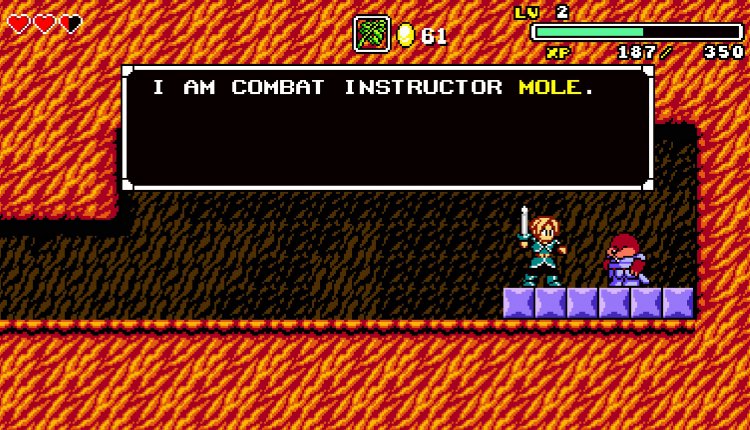
The combat in Aggelos is very fluid and satisfying. Controls feel tight and snappy, and at no point did I ever feel like there was latency or excessive amounts of buffer to any inputs. You are given a basic sword slash which is the primary mechanic used throughout the game. However, the complexity in Aggelos’ combat lies in the sword-skills and elemental powers you achieve over the course of the game. I will refrain from elaborating in too much detail regarding the specific “powers” you unlock throughout the game so nothing is spoiled. What I will say is that most of the powers you unlock are pivotal to the progression of the game as they open up new combat options, and more importantly, allow you to progress.
Controls
Now when it comes to the combat in Aggelos I have to address the elephant in the room, the default controls on Steam. The game does not have native controller support unless you’re playing the game on one of the console versions. Thankfully, it was not difficult to browse to a community controller config for my Dual Shock 5 and quickly jump into playing from the couch. That said, Aggelos is the type of game where you will want to use a controller with a VERY reliable D-Pad.
Once set up, Aggelos’ controls are true to the era of gaming that it would have come from. Most commands can be performed by a single button press or a combination of two inputs. For example, using your Earth Elemental Power (Once unlocked) can be done by pressing Up + Attack. Needless to say, the combat feels very snappy, and I was never left with the feeling that any input I entered would not be reliably executed in real-time.
Enemies & Bosses
The progression of enemies & bosses is where Aggelos really shines. The game starts off relatively tame (even on Hard-Mode). This is purely a guess, but early in my first playthrough, I was left with an impression that the enemies’ animations and behaviors were a direct result of the developer “learning” how to make a game. In other words, I have a feeling Aggelos was a learning-tool for the developer. This is purely a hunch though.
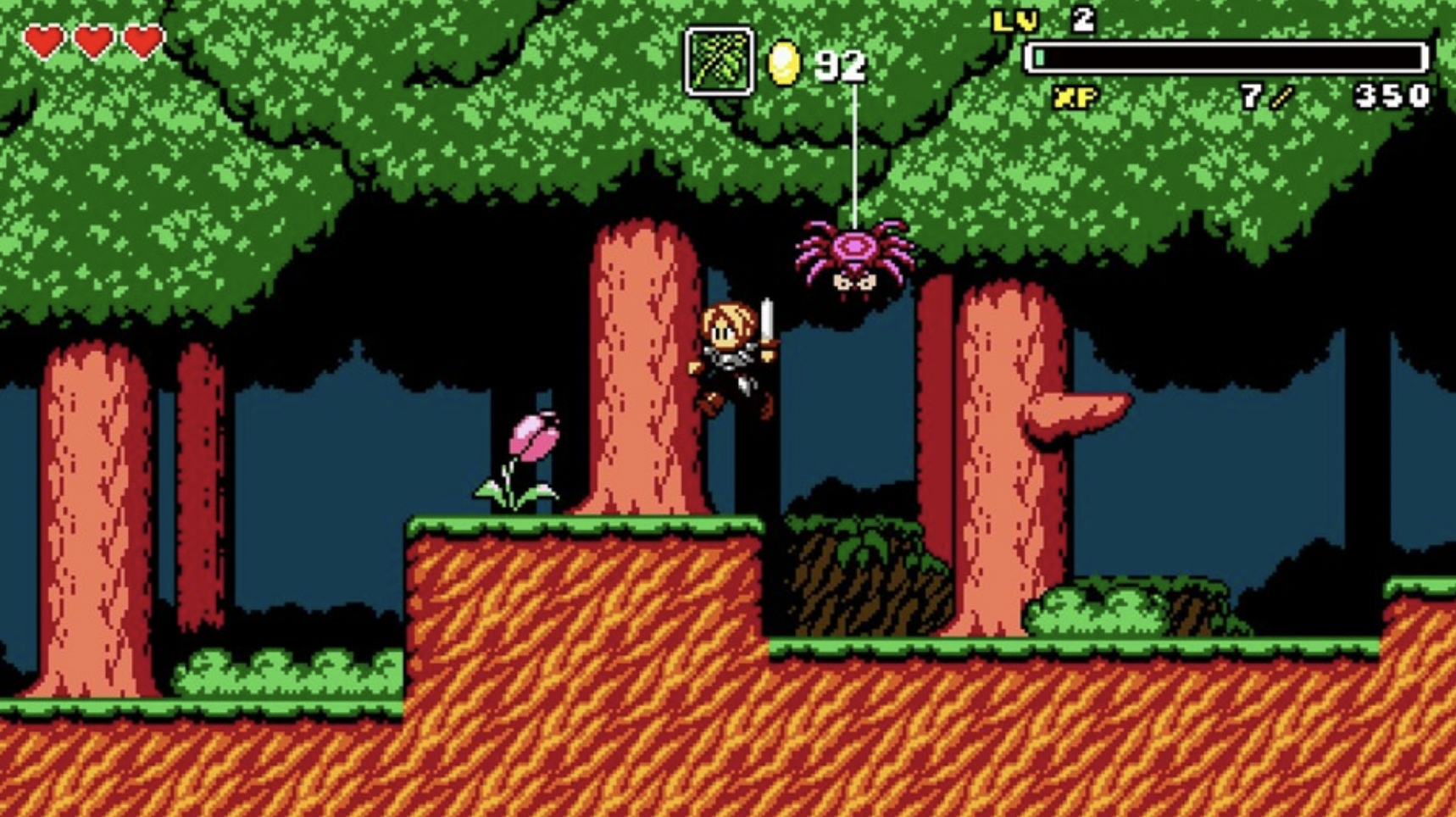
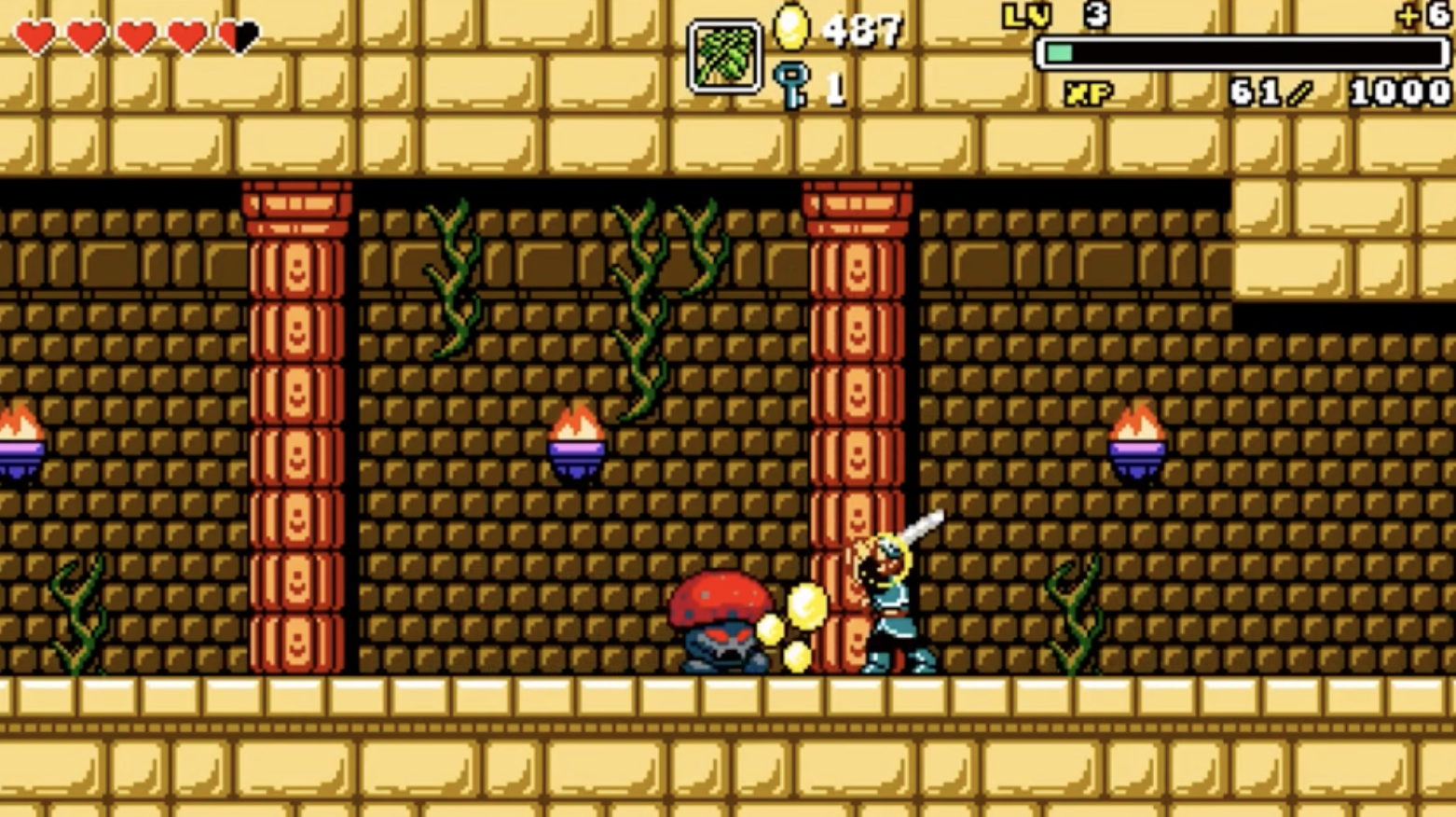
As you begin to progress through the game, steadily the enemies become more difficult, adding much more engagement and complexity to the choice of combat used to triumph over foes. I could dive deeper into this, but I think it’ll become pretty self-explanatory once you jump in.

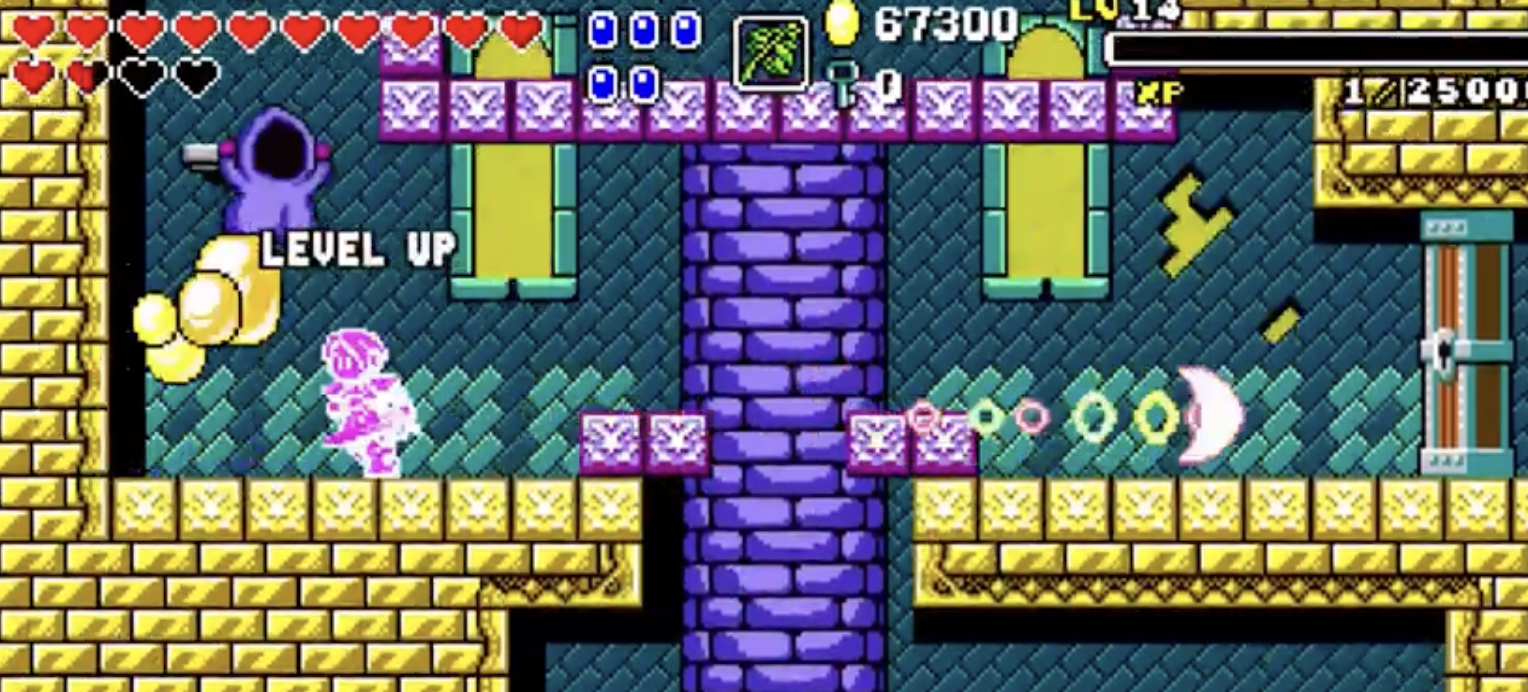
There is a leveling-up system in place to help facing those tougher enemies that you will encounter. However, I cannot help but feel the leveling system could use better implementation. Leveling up serves only one function—providing slightly more damage with your sword. Now I didn’t actually crunch the numbers, but I would wager upgrading your gear through the different shops you encounter throughout the game has more of an effect than the leveling system by a mile. With all that said, it’s hard to nitpick further because the game feels relatively balanced.
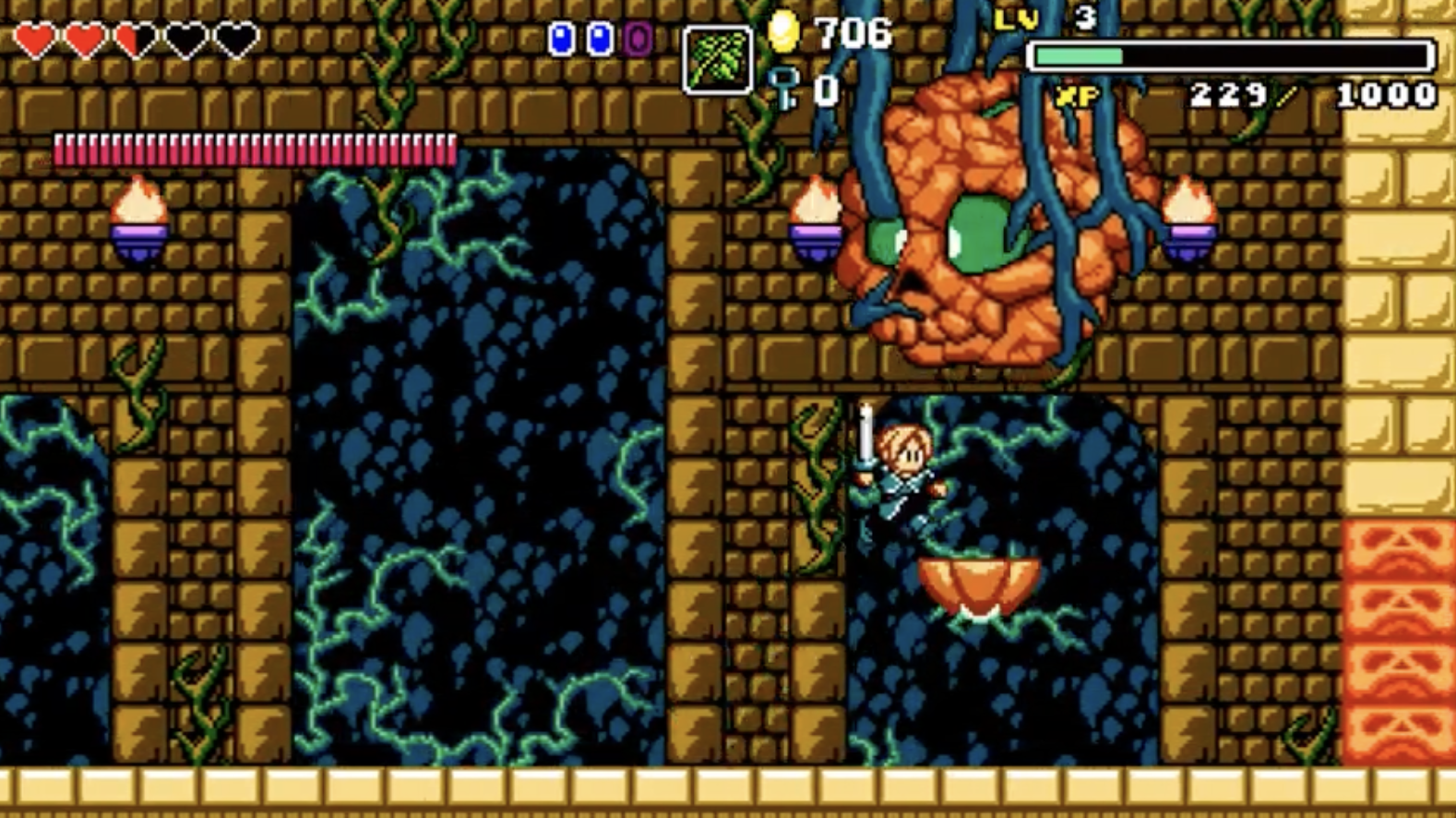
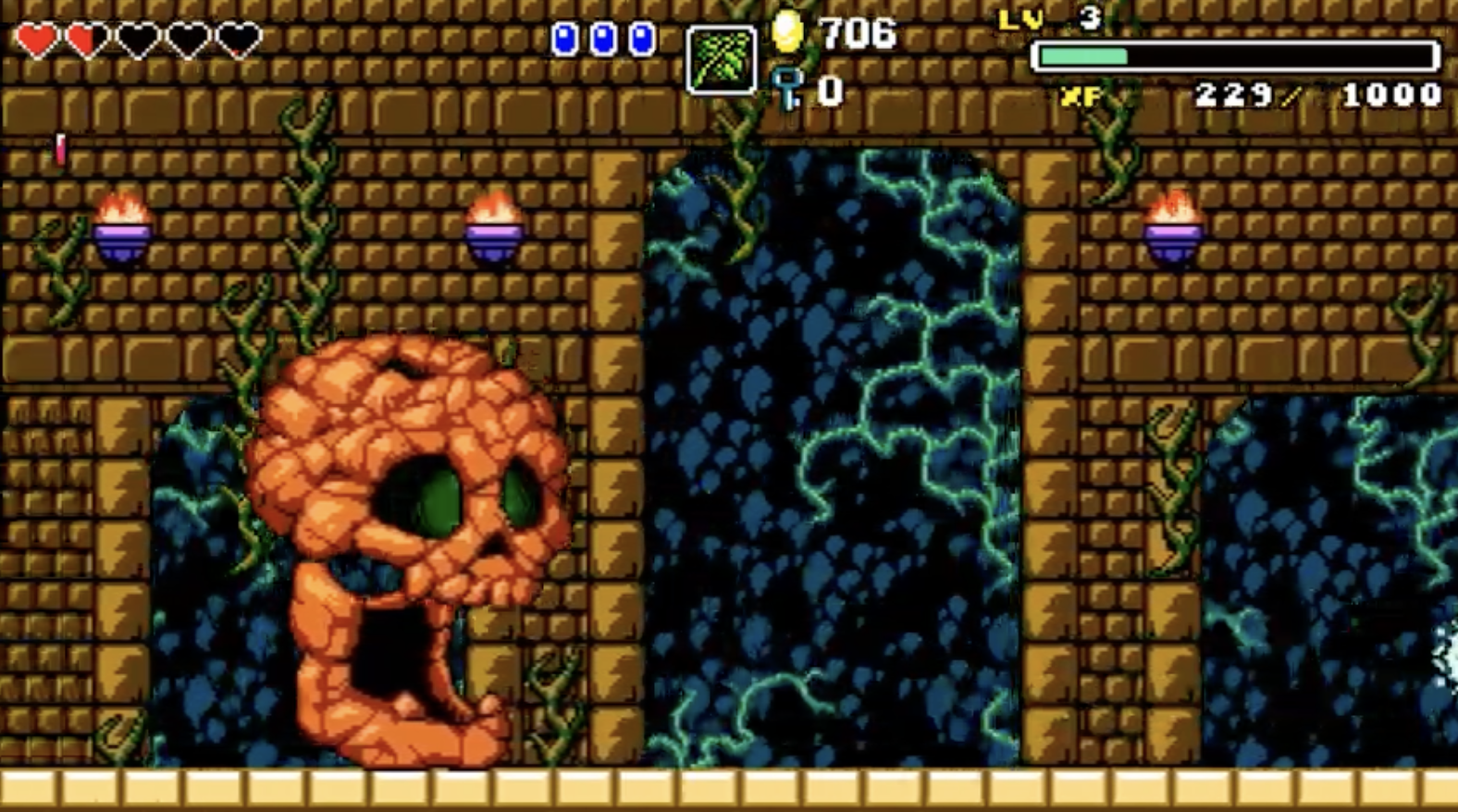
For those playing Aggelos in Hard-Mode, fighting bosses is where the majority of players will find the most difficulty in the game. I will add, that defeating a boss in Aggelos feels VERY satisfying. Just like the enemies, bosses will progress in their difficulty as you progress. The first boss being a giant skull with attack patterns that Metroidvania pros will easily adapt to and defeat. Something that I found quite engaging is that each boss encourages the player to use Elemental abilities that are unlocked leading up to a boss. Overall there is a solid balance between the length of time it takes to defeat a boss from start-to-finish vs. the difficulty of the boss’ attacks.

Visuals
Aggelos visually looks like a game that would have fit right into the Super Nintendo or Sega Genesis ecosystem. I personally found the pixel art to be stunning. Each area has good visual contrast, and really helps you believe you are progressing through a unique world that is thoughtfully designed. The same can be said for the NPC, enemies, and bosses as well—each being unique and thoughtfully designed. It never felt ambiguous where I was or what enemy I was confronting.


I think it is fair to say, within the scope of games Aggelos is trying to resemble, it does a fantastic job. That said, there are certain points where I found the visuals fell short as it relates to gameplay. What I found particularly frustrating at times is where certain enemy attack boxes relate to your character’s hurt-boxes; there are times where it will appear you are not within range of an attack but will take damage. The times I have encountered these issues were seldom, but I felt it was worth noting. Lastly, the only other gripe I had with the visuals, was that the crouching animation is relatively deceptive on how little distance your character travels when performed. This made it so I would more often than not opt to jump over an enemy attack instead of trying to crouch underneath.
Audio
There is not too much to praise or criticize in this area of the game. The audio is clear, punchy, and engaging enough to feel immersed. The sound effects are clear enough that each action is well connected with what’s happening on the screen. However, it does not have anywhere near the fidelity or quality compared to other Metroidvanias out there like Castlevania Symphony of the Night. So if you’re hoping for top-notch production, look elsewhere, or mute the game and put on some Lo-fi music. The only last thing that I’ll add about the music is that it at times felt a bit repetitive, to the point where I considered hitting the mute button if I spent too much time in any one particular area.
Exploration
Each area in Aggelos has a clear purpose. This isn’t necessarily a bad thing, however, I was left wishing that there was more incentive to stray from the core-missions of the game. Don’t get me wrong, there is some variety outside the linear dungeon progression, but judging the game in its entirety, it’s lacking. There are few areas in the game that encourage trying to get difficult to reach platforms or find breakable walls. Maybe I’m old-fashioned, but I find scavenging for that secret potion, hidden chest of gold, or unique abilities that aren’t crucial to beat the game, to be one of the most enjoyable parts of a Metroidvania.
The world is relatively small, and you will not be wasting too much time backtracking from one area to another. Some Metroidvanias get this horrendously wrong, and so much of the player’s time is wasted just going from point A to B. You will not find that to be a problem in Aggelos. Later in the game a fast-travel system is unlocked as well, which is probably the only means in which the built-in world map is actually useful.
The best aspect of exploration in Aggelos is the clear transitions from environment to dungeon. Every time I progressed to a new Elemental Dungeon, I felt a certain thrill and excitement; the enemies, music, and scenery would all suddenly change in a way I could not help but rise to attention and focus intensely. The same could also be said about entering into a Boss Battle—total immersion.
Achievements
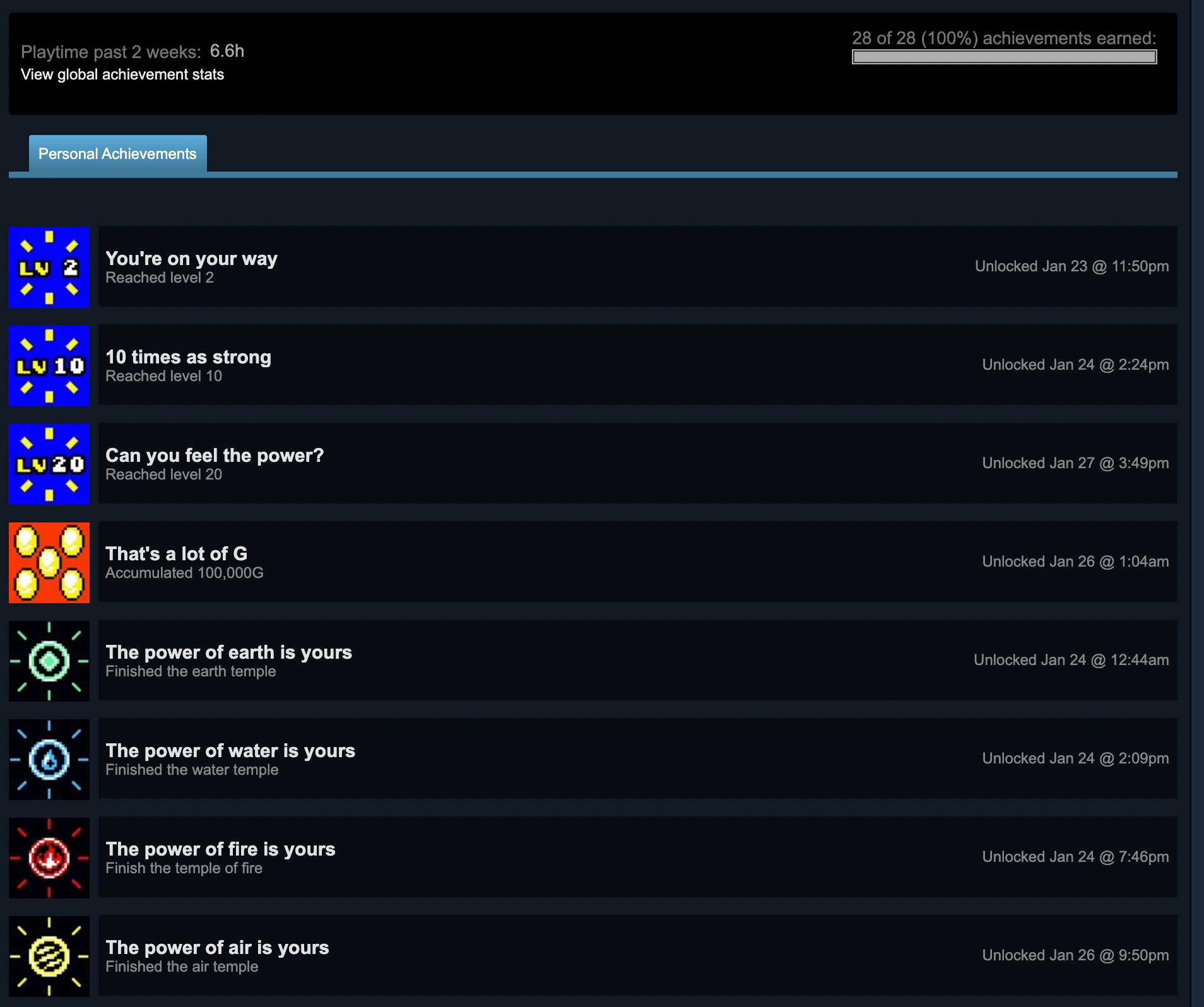

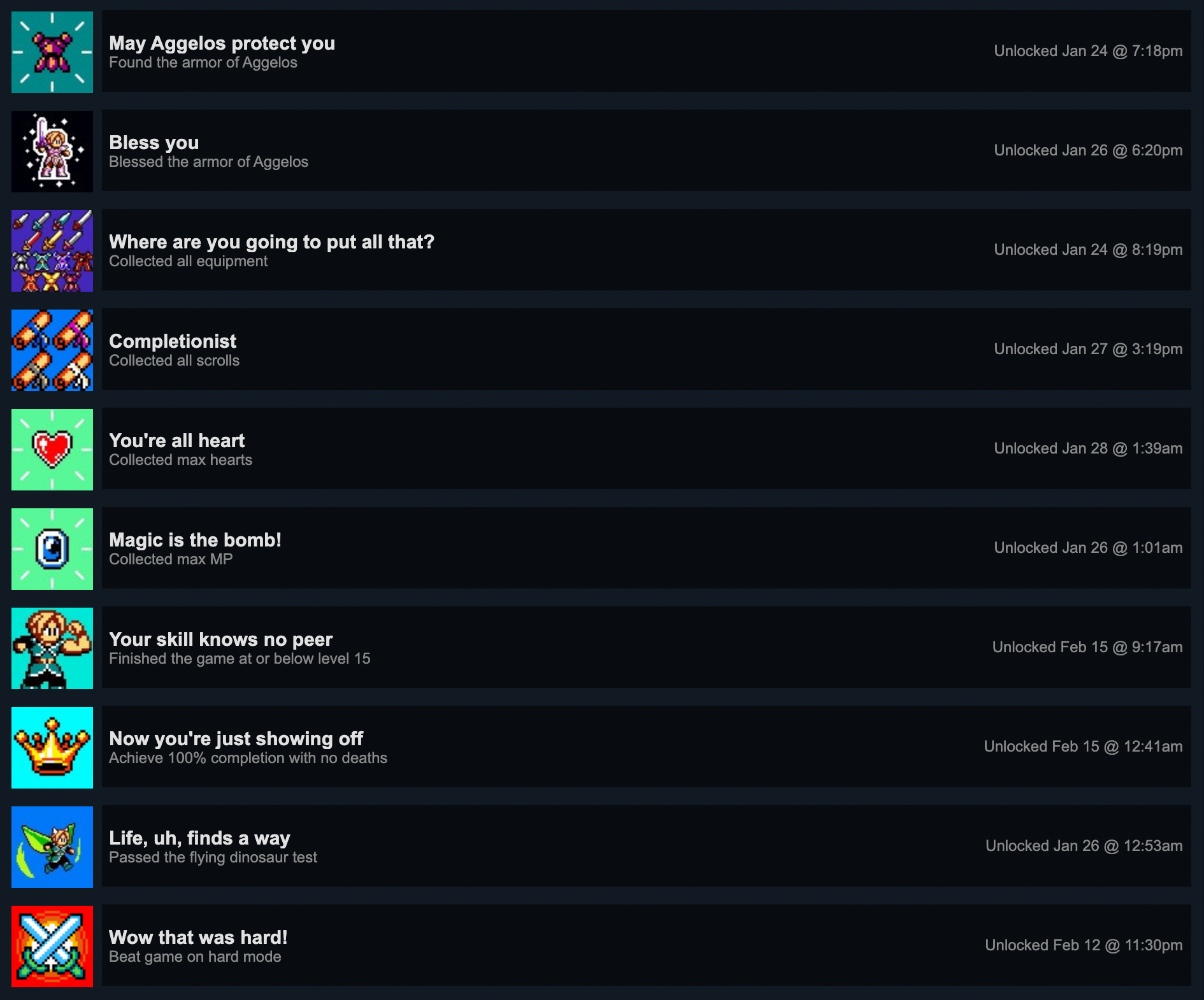
Collecting all the achievements in Aggelos I found to be an enjoyable experience. There were no achievements where I felt I had to forcibly grind for too long, or do something incredibly arbitrary.
The majority of the achievements will be collected by just progressing through the game naturally. Depending on your approach you may find yourself going back for two to three playthroughs to collect all the achievements.

Most players will probably find the most difficult-to-obtain achievement to be Now you’re just showing off, the achievement requires that you Achieve 100% completion with no deaths. Now the “no deaths” part is pretty self-explanatory, but what does “achieve 100%” mean? Allow me to explain. “Achieve 100%” means getting all elemental abilities, defeating every boss (including a super-secret boss), obtaining all swords & armors, and obtaining all hearts. While 100% though may sound daunting, go back to what I said earlier in the review about there being few areas in the game to explore outside the linear progression of beating the game, and the lack of secrets; in other words, most of the aforementioned things above you will discover by just playing the game normally.
Final Thoughts
Replayability
Aggelos, while being a relatively short game in scope, is not a game I would necessarily go back for more. I may feel this way because the game required a couple playthroughs to get 100% achievements, however, once I got my last achievement, I was ready to uninstall it from my computer and write my review. I do not suspect I will ever go back and play this game again.
The Good
- Tight and fluid controls
- Beautiful pixel art style graphics that resemble a Super Nintendo or Sega Genesis game
- Charming audio-track that does not attempt to be more than it is
- Great combat mechanics
- Not much time wasted traveling
- Achievements that felt rewarding to obtain
- Hard Mode is available from the start (my preferred way to play)
- Difficulty scales in a very organic way as you progress through the game
What Could Be Improved
- The Story
- NPC Dialogue
- Crouching animation of the player
- The visual map of the world
- Hit Boxes & Hurt Boxes of the player and enemies
- Quantity of areas to explore
- Repetitive Music
- Implementation of the leveling system
- Adding Co-op to the game would be nice
- Native controller support on PC version
Verdict
To close out this review, Aggelos is a game that is fun, engaging, and charming. If I had picked this game up in the 90’s, I would have no doubt loved it. The tight controls, smooth combat, Metroidvania aspects, and rewarding boss fights, kept this game enjoyable and engaging through my entire first playthrough. I think the developers should be proud on what they have achieved here, and I would definitely be interested in the next installment of the Aggelos series.
 The Undisputed Travesty
I feel like playing this game now!
LikeLike
This blog is so good it make me SICK
LikeLike